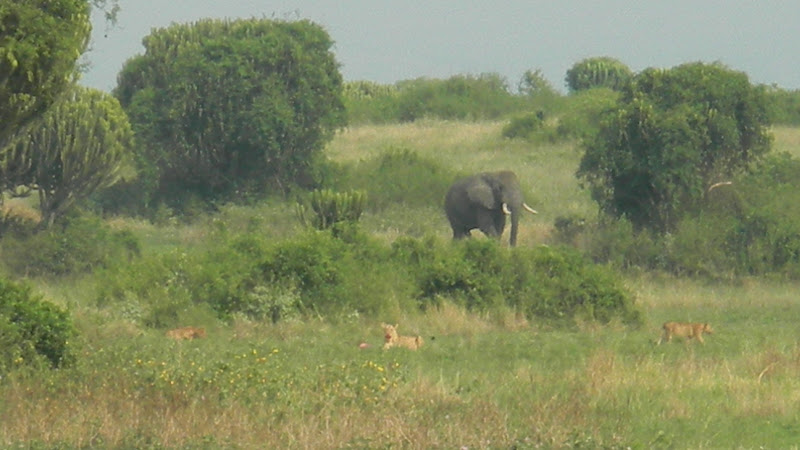
Queen Elizabeth National Park contains a series of volcanic explosion craters, many of which have become crater lakes.
Bunyampaka is now used by local people for salt pans; the lakeshore is divided into plots that are flooded with water, which leaches salt from the soil as it evaporates. The salt is then scraped off the surface and sold.
This is Nyamanuka lake. Water buffalo were grazing at the water's edge
Here is Kikorongo lake, where Queen Elizabeth's 1954 visit gave the National Park its name. The Duke of Edinburgh returned here in 2009 to open a new visitor center.
We passed several more of the beautiful Ndali-Kasekende crater lakes as we drove out of the park through Kasese and past the Rwenzori mountains to Kibale National Park.
Friday, September 14, 2012
Birds at Queen Elizabeth National Park
We saw more birdlife in the savannah on our final game drive:
Brown snake eagle
Grey backed bush shrike
African white backed vulture with carrion
Grey heron
Red bishop (southern)
Additional birds seen this day included gonolek, blue naped mousebird, palm nut vulture, bustard, browed white coucal, crowned lapwing, saddle billed stork, white browed robin chat and a flock of red billed quelea.
Lions!
Not long after sunrise we came across a pride of eight lions feasting on a kill. We drove close and then retired to a distance to watch.
As the sun grew hotter the lions shifted position.
Eventually they retreated into a thicket to sleep.
As the sun grew hotter the lions shifted position.
Eventually they retreated into a thicket to sleep.
Thursday, September 13, 2012
Mweya Lodge
Mweya Lodge sits in a superb location overlooking the Kazinga channel, through which Lake George drains into Lake Edward.
We watched buffalo and hippo on the far bank while sitting on the terrace eating lunch. Our room, a luxurious tented cabin, also overlooked the channel.
Having had our tent invaded by monkeys at Mihingo Lodge four nights earlier, it was the turn of an army of ants to come marching in through the gap beneath the door. We decamped to the neighboring tent and ensured that paraffin was poured around the perimeter and all gaps stuffed with towels to prevent any more unwelcome nightly visitors.
After the ant episode, we went for dinner. It was 9pm by now and we needed some wine to unwind, so we ordered two glasses of chablis, and watched the bats flying low outside the windows. After a while the waiter returned with a random bottle of red wine, which we sent back. More time elapsed and the waiter reappeared with two glasses full of an amber liquid which one sip confirmed was either really 'off' wine or more likely apple juice. Eventually we got some acceptable white wine and then waited for our meal. After an hour and a half the staff informed us they were closing the restaurant and would we move to the bar - and promptly turned off all the lights!
A pre-lunch swim and a very delicious lunch accompanied by friendly weaver birds the next day went some way to restoring faith in Mweya Lodge but needless to say we did not leave a tip!
Kazinga Channel
As soon as we arrived at Mweya Lodge we rushed down to the jetty to catch the 4:15pm Kazinga Channel boat ride. The channel connects Lake George with Lake Edward.
The shores were teeming with wildlife; I could hardly write down the names of the birds that we saw fast enough. These included skimmers, least terns with red bills, goliath heron, grey heron, yellow billed stork, saddlebill stork, great egret, little egret, yellow billed egret, sacred ibis, hadeda ibis, spoonbill, pink backed pelicans, cormorants, African fish eagles, Egyptian geese, water thickknees, black crake, sandpiper, stilt, plover, hamerkop, pied kingfisher, malachite kingfisher, red bishop, palmnut vulture.
This is a spoonbill - notice its spoon shaped bill. It was the first and only one I saw in Uganda.
Goliath Heron
Pied kingfishers nest in holes in the riverbank and hover high over the water when fishing.
Black crake - walking very fast!
Egyptian goose
Yellow billed stork keeping a beady eye on a crocodile
Sacred ibis
Red / yellow bishop
African fish eagles pair for life.
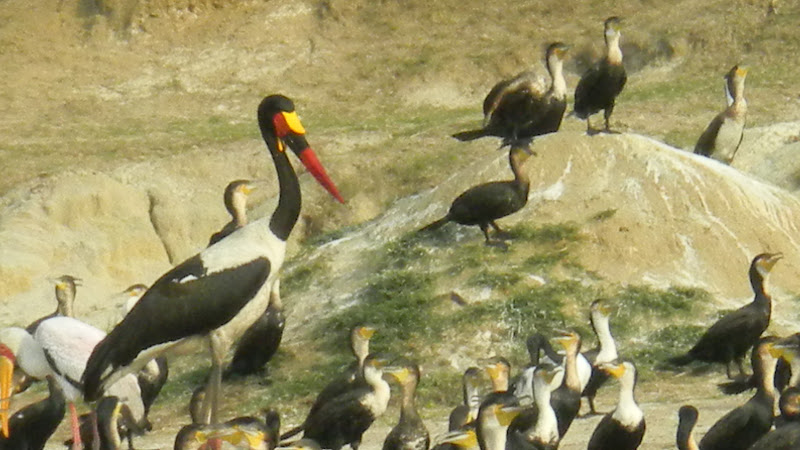
Saddle billed stork among cormorants.
Palm nut vulture
Pink backed pelicans
These two water thickknees were defending their nest from a predatory monitor lizard.
There are several fishing villages on the lakes.
The highlight of the cruise was the sighting of six lions; one in the thickets and the others sunning themselves on the cliffs.
As we drew near to the lions lightning started to flash in the distance and then the rain came with huge thunderclaps so we sped back across the channel and to Mweya lodge.
The shores were teeming with wildlife; I could hardly write down the names of the birds that we saw fast enough. These included skimmers, least terns with red bills, goliath heron, grey heron, yellow billed stork, saddlebill stork, great egret, little egret, yellow billed egret, sacred ibis, hadeda ibis, spoonbill, pink backed pelicans, cormorants, African fish eagles, Egyptian geese, water thickknees, black crake, sandpiper, stilt, plover, hamerkop, pied kingfisher, malachite kingfisher, red bishop, palmnut vulture.
This is a spoonbill - notice its spoon shaped bill. It was the first and only one I saw in Uganda.
Goliath Heron
Pied kingfishers nest in holes in the riverbank and hover high over the water when fishing.
Black crake - walking very fast!
Egyptian goose
Yellow billed stork keeping a beady eye on a crocodile
Sacred ibis
Red / yellow bishop
African fish eagles pair for life.
Saddle billed stork among cormorants.
Palm nut vulture
Pink backed pelicans
These two water thickknees were defending their nest from a predatory monitor lizard.
Hippos and buffalo wallowed in the riparian mud
There are several fishing villages on the lakes.
The highlight of the cruise was the sighting of six lions; one in the thickets and the others sunning themselves on the cliffs.
As we drew near to the lions lightning started to flash in the distance and then the rain came with huge thunderclaps so we sped back across the channel and to Mweya lodge.
Leopard!
We had been a little disappointed in the morning at not seeing a single lion, let alone a tree climbing one. However when a large male leopard crossed the road in front of us we forgot about the lions - this was a much rarer sight. We followed him for a while, his white tail held high and waving in the long grasses.
Elephants!
As we neared Mweya Lodge in Queen Elizabeth National Park, we happened on this herd of elephants. We counted seven in all.
Subscribe to:
Posts (Atom)